
Inside the Heating Core
Heating architecture has several corners, and mesh count covers only one. The sensations you notice get decided elsewhere: by power, airflow, resistance, wicking and the control logic driving it all.
Evidence date: August 19, 2026.
No default victory belongs to dual mesh. Only when a dual-mesh build simultaneously brings more heating surface into play — or raises power alongside airflow — does a noticeable gap become probable.
Done that way, the reward is warmer, denser clouds — paid for in battery energy and e-liquid burned faster on each draw. On its own, mesh count says nothing about flavor quality, smoothness or how long the hardware serves. Vapmo performed no controlled side-by-side testing for this guide; what follows weighs documented implementations against their blind spots.
Defining the Two Labels
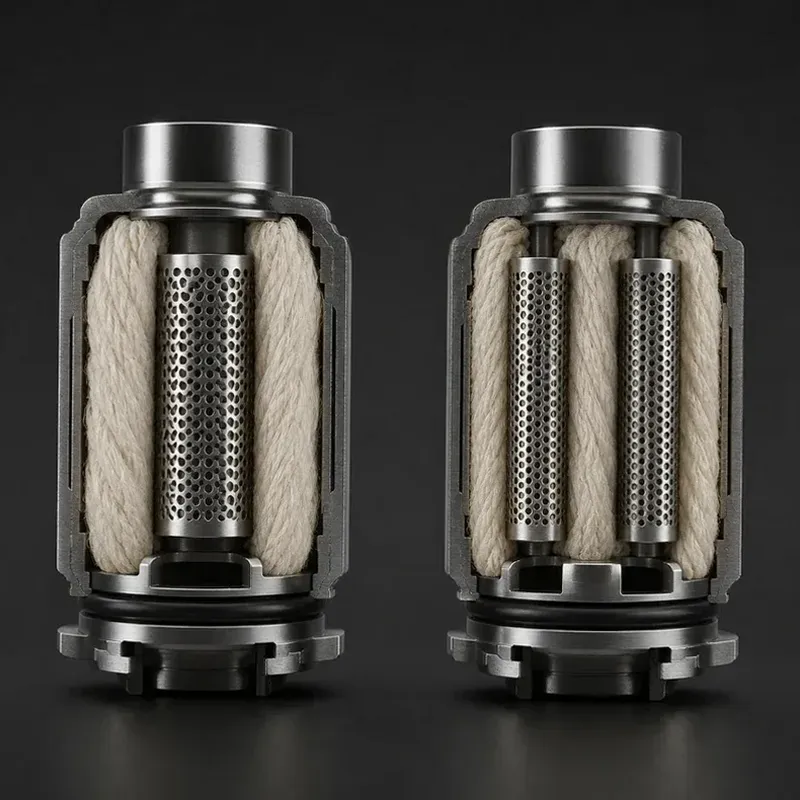
Single mesh means exactly what the words say: one mesh heating element. Dual mesh generally points to two elements, or two heating zones — while the electrical choreography behind them differs from one product to the next.
Watch the control logic closely. Depending on the device, those two meshes may fire as a pair, hand work back and forth, or swap roles when the mode changes — so the phrase dual mesh describes no single, standardized way of operating.
The Differences a User Could Feel
| Candidate difference | Conditions that surface it | Other variables in play | How solid the evidence is |
|---|---|---|---|
| Warmth and cloud volume | When the dual-mesh design activates added heating surface, or raises output and airflow at the same time. | Draw length, resistance, airflow, the power mode, and which sections fire. | Conditional — documented by makers in certain systems, plausible there, not universal. |
| Battery drain | When the mode in question demands extra power for each puff. | Control logic, draw length, power delivery, and battery capacity. | Conditional — output drives it; the dual label alone does not. |
| E-liquid consumption | When output climbs and each puff vaporizes additional liquid. | Wick design, liquid supply, draw behavior, airflow, and power. | Conditional — the direction is certain as output rises; no fixed percentage exists. |
| Smoothness and flavor quality | Only as an outcome tied to the specific model and the specific preference. | Temperature, liquid, wick, airflow, device settings, plus a controlled tasting method. | Unresolved here — Vapmo performed no sensory test. |
| Coil or pod service life | Only once the complete operating system and the usage pattern are both known. | Draw frequency, wicking, liquid, power, the alternating logic, and general care. | Mesh count alone cannot predict it. |
Read the matrix as a wedge between the label and the conditions that make the label mean anything. Two options rarely change mesh count alone — power, airflow, resistance and mode typically move together with it, so what reaches the user is the combined system, never an isolated “dual mesh effect.”
Why One Label Can’t Call the Outcome
Resistance Never Exposes the Architecture
An electrical load is what nominal resistance measures — full stop. Whether a single mesh section or a pair lives behind it stays hidden. Overlapping resistance values appear across Vaporesso’s single- and dual-mesh range. For the exact coil, pod and device, compatibility plus the maker’s recommended operating window remain things you verify yourself.
Output and Air Edit the Experience
Turn on an output-raising mode and warmth plus vapor density climb — while battery and liquid consumption get redrawn at the same time. Airflow waits as its own comparison variable. Leave power and airflow untamed and no single-versus-dual experiment can isolate the mesh count.
Wick, Liquid and Draw Habits Never Leave the Equation
Between wicking behavior, the liquid chosen, personal draw habits and the device’s control logic, the outcome gets bent in several directions. Which is why no mesh-count label promises flavor, smoothness or lifespan.
Three Products, Three Answers
Lost Vape E PLUS: Per Lost Vape’s technical comparison, this product-specific system runs its two meshes as a pair in one mode, then swaps between them in a second mode. Two heating sections, two steering strategies — proof that control schemes differ, not that all dual-mesh devices converge on one result.
Vaporesso GTX family: In the LUXE XR MAX 2 documentation, Vaporesso lists GTX coils in single- and dual-mesh forms whose nominal resistance values overlap. Narrow takeaway: resistance and mesh count are two different specifications. Universal gaps in power, taste or lifespan are not proven by this.
Geek Bar Pulse: The current Vapmo Geek Bar Pulse listing shows a live-store implementation: alternating mesh coils inside a product that separately toggles Regular and Pulse output modes. Any difference a user notices belongs to that whole implementation — stock, the sold version and product facts are all rechecked before publication.
Rankings are absent from all three examples by design. What they demonstrate is a two-word label riding happily across products that differ in resistance, firing pattern, power mode and intended purpose.
The Six Checks Worth Running First
- Exact compatibility: the coil or pod must match the device — and the exact version the manufacturer names.
- Resistance: trust the stated option; mesh count is not a proxy for it.
- Recommended power: the manufacturer’s range governs — or, on a closed system, its controlled settings. Universal wattage rules do not exist.
- Airflow: ask what adjustment exists and which draw style it serves.
- Liquid and wicking guidance: follow the guidance printed for that product; mesh-and-liquid pairings do not behave alike.
- Control mode: find out whether both sections fire at once, alternate, or answer to mode-based output shifts.
Boxes ticked, browse the Vapmo Disposable Vape category to compare the models listed today. That category displayed 19 results at the August 19 evidence check, with mesh and dual-mesh features among the specs that vary.
Choosing Between Them
The exact single-mesh option earns the pick when its resistance, compatibility, recommended power, airflow and control behavior line up with the device and the use you have planned. Weak output or longer battery life is not what “single” guarantees.
A dual-mesh option deserves weight when its documentation spells out how the two sections operate and the higher-output tradeoffs match your priorities. Products that also lift power or airflow may register warmer, denser output — paid for through faster battery and e-liquid burn per draw. Conditional, never promised.
The decision rule stays simple: whole systems are what you compare. The mesh count narrates part of the hardware story; whether the label changes anything you can feel is settled by compatibility, resistance, power, airflow, wicking and control logic together.