
Charging guide · Meant for adult readers aged 21+
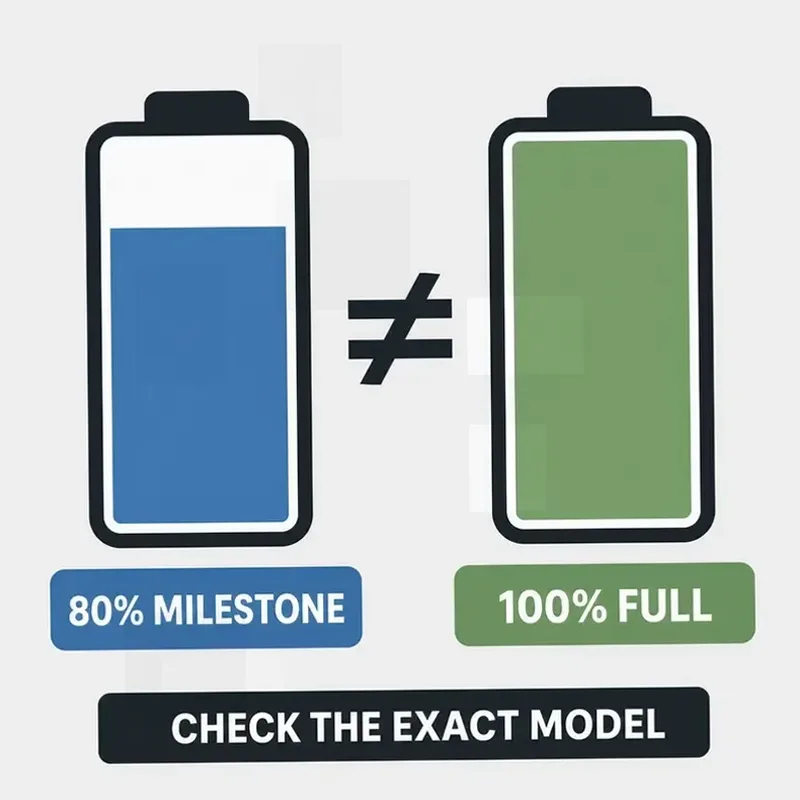
Quick Answer: No single charging time applies to rechargeable disposables as a category. Many of the newer fast-charge devices are finished long before the broad windows quoted all over the internet. For example: GEEK BAR says the Pulse X sold at Vapmo reaches 80% after 20 minutes — and nowhere on that page is 20 minutes presented as a full 100% charge.
Let the exact model set the clock — its battery display or charge indicator, read alongside the maker’s own instructions. A published full-charge time is there to be obeyed. What never works is stretching one percentage waypoint, or one model’s indicator, into a timer for everything.
Evidence limitation: Official manufacturer pages and U.S. government sources form the basis of this guide. Nothing was plugged in or timed while the article was being written, and battery-capacity arithmetic was never used to produce a duration.
Charging a Disposable: How Long, Really?
Truthful reply: each model answers that question differently. Those sweeping windows circulating online are rough planning figures — safety cutoffs they are not, and no yardstick exists that the whole rechargeable category fits into. Battery state, charging electronics, input tolerances and the way completion gets announced differ too much between today’s devices.
Step one is confirming the device recharges at all. Somewhere — the box, the leaflet inside it, or the maker’s own product page — a manufacturer-sanctioned charging method should be documented. Should no approved method show up anywhere, stop and put the question directly to the manufacturer or seller.
Instructions that print a full-charge time are speaking about one model, one version — treat them literally. Where the maker published only a partial waypoint — 80% inside 20 minutes, say — the endpoint remains the maker’s, untouched. And where no figure exists anywhere, put your trust in whatever that model documents for its display, icon, LED behavior or charging animation, and leave estimating out of it.
Why the Duration Won’t Collapse Into One Number
Two devices can share a port type and still refill at entirely different speeds. What actually moves the needle:
- Remaining battery: a nearly drained cell has far further to travel than one hooked up while sitting at 40%.
- Battery capacity: cell size matters, yet size alone never produces a precise figure.
- Charging circuitry: the hardware inside decides how, and how fast, incoming power gets handled.
- Supported charging input: some models insist on a specific cable, adapter or input rating before they behave.
- Fast-charging capability: one device is engineered to reach a quoted percentage at speed; a sibling from the same family claims nothing of the sort.
- Device-specific design: screens, percentage counters, icons, LEDs and the logic overseeing the charge vary from product to product.
USB-C labels a plug shape — that is the whole claim. It guarantees no faster refill, and it certainly doesn’t make every USB-C brick a suitable partner. Follow the charging route your particular device’s maker recommends; where the maker publishes input requirements, those words carry final authority.
Cases Documented on Official Pages
Vapmo currently stocks every device listed below. Why show them? Because endpoints deserve scrutiny: exactly one entry carries a manufacturer-documented percentage waypoint, while the others publish no full-charge figure that would be safe to borrow. Speed ranking, this is not.
| Model | What the makers’ pages say | Reading it correctly |
|---|---|---|
| GEEK BAR Pulse X | On the official Pulse X page, the device is listed as reaching 80% within 20 minutes. | 20 minutes purchase 80% — nothing beyond. A 100% number appears nowhere on that page. |
| GEEK BAR Pulse X2 50K | A 1000mAh battery is confirmed by the official Pulse X2 page; Vapmo’s present listing adds a USB-C fast-charging note. | No total time is stated there. Don’t import the milestone belonging to the original Pulse X, and don’t wring minutes out of mAh math. |
| ELFBAR Ice King Pro 40K | Type-C charging and a 5V DC, 1.5A input are spelled out on the official Ice King Pro page — charging duration goes unlisted. | With no total time given, honor the published input spec and refuse to calculate minutes from capacity or plug type. |
Recognizing a Full Battery on Your Own Device
Whatever finish signal your specific model documents, that is the one to watch — a percentage counter perhaps, a battery icon topping off, an animation crawling across the screen, an LED doing its dance. Brands keep these schemes to themselves; nothing ports across.
Disposable vapes obey no shared industry convention of red-while-charging, green-when-finished. A full-battery signal defined in the manual? Pull the cable the instant it shows. A light changing that no official document explains? Register it, but stop short of calling it proof.
Charging Without Rolling the Dice
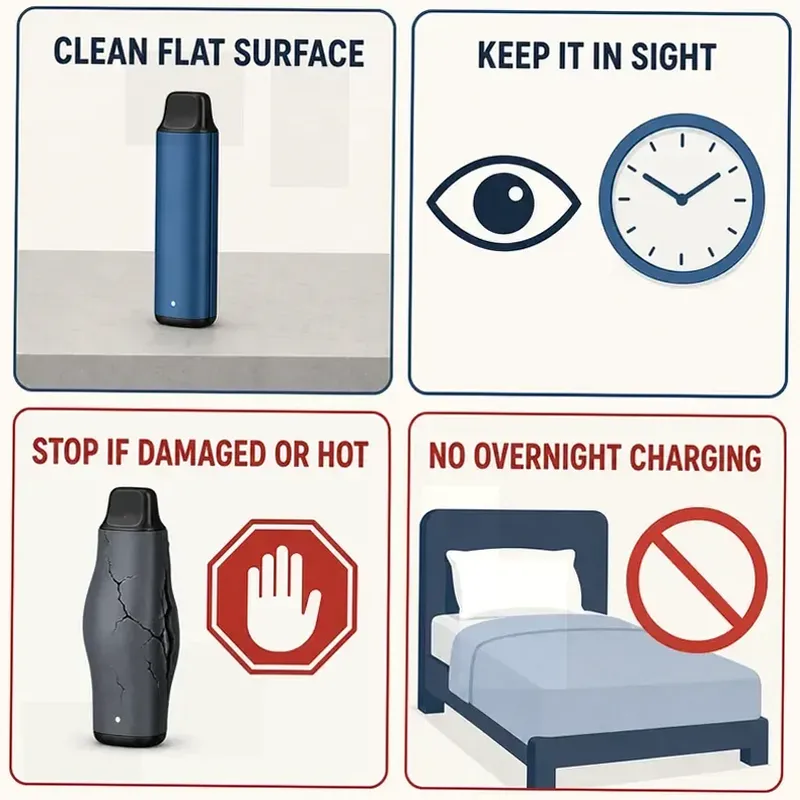
- Look the device over first. Cracked, swollen, leaking, discolored, unusually hot, hissing, popping, odd smell — anything matching that description, visibly damaged included, stays away from the charger.
- Give the model the method it asks for. “Fast” printed on a charger’s box is no verdict in either direction — right or wrong comes from matching the maker’s cable, input and requirements for the device in hand.
- Keep the session inside your line of sight. What the FDA recommends is a clean, flat surface in view and well away from anything that burns.
- Unplug when the documented finish arrives. Some devices do carry charge-protection features — still not a license to keep an unfamiliar model connected once the readout says full.
According to the U.S. Fire Administration, a lithium-ion battery has reached retirement once it shows excessive heat, discoloration, leaking, odor, a change in shape, or strange noises. The EPA adds a warning of its own: prying a battery or nicotine cartridge loose from where it is embedded can ignite a fire, so removal is off the table. Keep the device intact; once every documented charging route has been tried, hand the issue to the manufacturer or the seller.
When Plugging In Produces Nothing
Three checks settle the basics: does the model actually recharge, is that port genuinely its intended charging connection, and do the instructions name a cable or power source? Then watch for a reaction — screen, icon or LED — and interpret it strictly through that product’s own documentation, never through the color chart of some other brand.
If the documentation describes no charging response at all, stopping beats improvising past the maker’s method. A brand-new disposable vape that won’t work is a job for Vapmo’s first-use guide, which walks through the support-and-return decision. Here the scope stays on charging behavior; diagnosing sealed devices is a different lane.
How Often a Disposable Wants the Charger
Plug in when the model itself asks for it — via its battery display, its low-battery icon, or the maker’s instructions. Usage intensity, charge remaining, active operating mode and hardware design set the rhythm; a hard-coded daily or weekly rule collapses the moment products change.
Rhythm of charging and total product lifespan are different conversations, too. While usable e-liquid holds out, a rechargeable cell will happily absorb one top-up after another; once liquid or coil is spent, though, no charger brings a sealed disposable back. That lifespan question has its own piece — how long a disposable vape lasts. Adults weighing today’s rechargeable disposable vapes should nonetheless open each product’s charging documentation before the first session.
Charging Questions, Asked and Answered
Does a charging cable ship inside the GEEK BAR Pulse X box?
No. According to Vapmo’s current Pulse X 25K listing, the USB Type-C charging cable is excluded. Check what the package of your chosen product actually contains, then obtain a charging accessory fitting the model’s requirements — assuming one comes included would be a mistake.
Can a charge put fresh e-liquid into a sealed disposable?
Never. Charging restores battery power, and only on hardware built to recharge; the e-liquid supply the device shipped with is fixed for good. Rechargeable and refillable name two entirely different traits.
Is overnight charging on the table for a disposable vape?
It isn’t. FDA vape-battery safety material instructs users against charging a vape overnight or abandoning it plugged in unattended. Keep the session in sight and unplug once the documented full signal arrives.
While it charges, can the disposable still be used?
Passthrough support is not a safe assumption. Unless that model’s instructions explicitly permit it, keep the device unplugged before use. The capability is granted model by model — a USB-C port grants precisely nothing.
Is charging a vape during a flight allowed?
Cabin charging and travel rules make a subject of their own, written by whichever carrier or authority controls them that day. Read Can You Take a Vape on a Plane?, Vapmo’s guide built for flights and packing, instead of carrying this at-home charging advice onboard.
A device I can’t charge safely — now what?
Handling directions come from the seller or the manufacturer. If the device isn’t going back, the EPA tells individuals to keep e-cigarettes out of household trash and recycling and suggests exploring a nearby household hazardous waste collection program.