
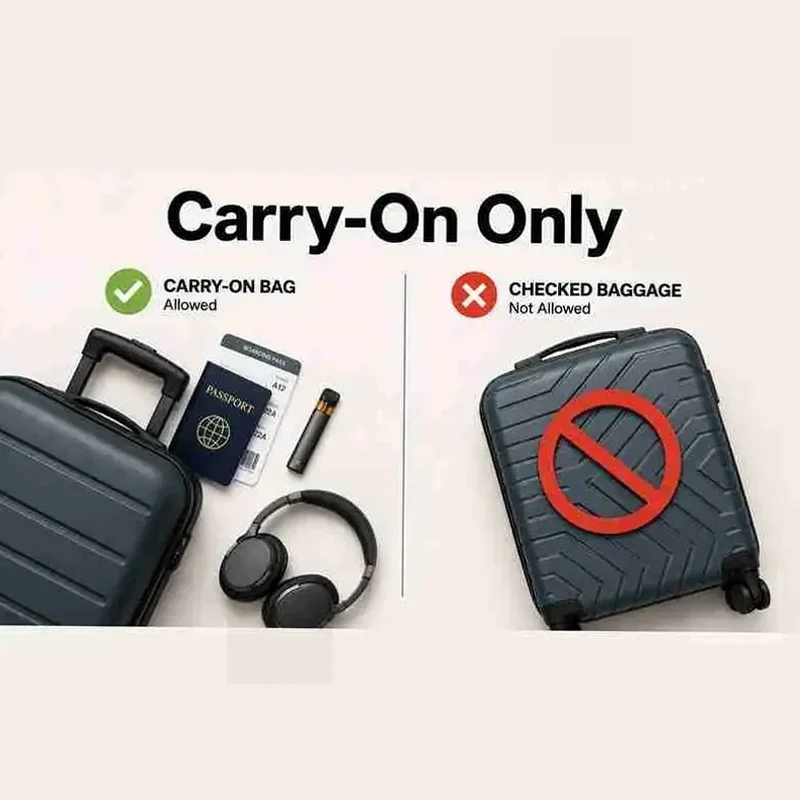
Yes — U.S. flights allow a vape aboard, disposables, pens, and pod systems alike, as long as it travels on you or inside your cabin bag. The hold is closed to vapes, and neither using nor charging one mid-flight is permitted. E-liquid riding in the cabin must occupy containers of 3.4 oz (100 mL) or smaller.
Last checked: October 22, 2026. This guide keeps U.S. screening and aviation rules distinct from airline policy and from the law at your destination. Rules drift, so double-check with your carrier and destination before you fly.
| The question | U.S. answer today | Who owns the rule |
|---|---|---|
| Cabin bag or your pocket? | Yes | FAA / TSA |
| The cargo hold? | No | FAA / TSA |
| Vaping or charging at altitude? | No | FAA |
| Liquid in the cabin? | Yes — containers of 3.4 oz (100 mL) or smaller | TSA |
| Liquid down in the hold? | Yes | TSA |
| Disposables and pens? | Treated like every other vaping device | FAA / TSA |
| A quick puff in the lavatory? | No — the ban spans the entire aircraft | DOT |
| Legal where you land? | Verify separately | Destination government / customs |
Which Authority Owns Which Rule?
Traveling with a vape answers to several masters, never just one. This owner map is worth a read before the suitcase opens:
- FAA plus federal hazmat rules: where a battery-powered device may ride, how it must be protected, and whether onboard charging is permitted.
- TSA: what survives a U.S. security checkpoint — carry-on liquid limits included.
- Your airline: device-count or battery ceilings stricter than the federal floor.
- Authorities in transit and at the destination: the legality of possession, import, nicotine products, or specific flavors.
A clean pass through TSA says nothing about legality at the other end.
Is Checked Luggage Ever an Option?
No. Under the FAA PackSafe rules on e-cigarettes and vaping devices, the device must ride on your person or in cabin baggage. The FAA’s current passenger battery chart also files vaping devices under items banned from checked bags.
No excuse in the playbook changes it: powered down, untouched, factory-sealed, nicotine-free — still no. What decides the packing spot is the battery-powered hardware, never the nicotine label.
Do Disposables and Vape Pens Fly Too?
Yes. The FAA rule reaches vaporizers, atomizers, vape pens, e-cigarettes, and electronic nicotine delivery systems alike, which drops a disposable vape into the same carry-on-only bucket as a refillable pod system.
Inside every disposable sits a built-in lithium battery — boxed and brand new or not. That cell alone rules out the cargo hold.
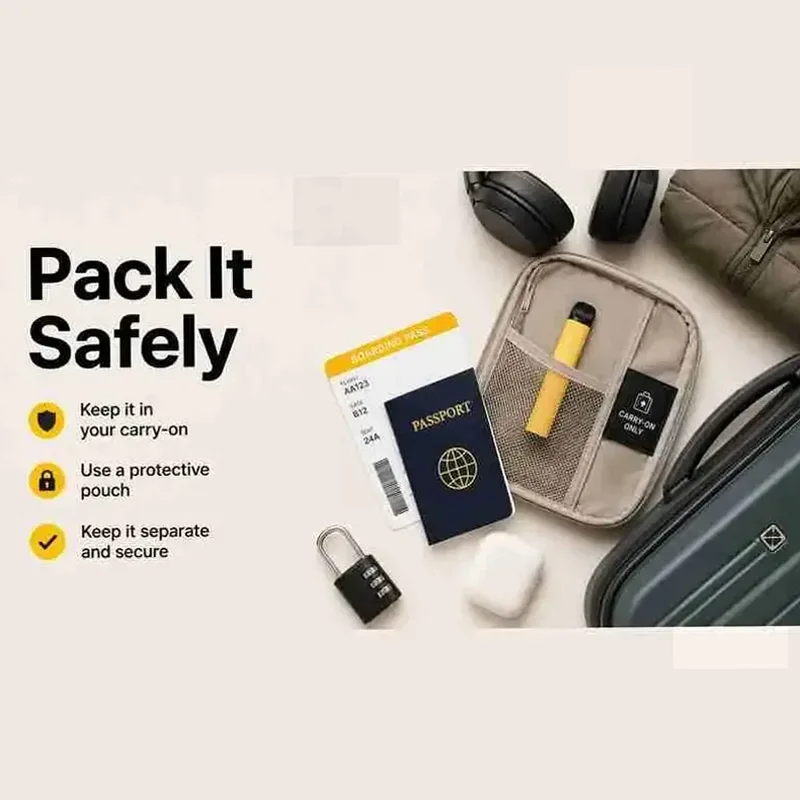
Many disposables arrive button-free and lock-free, firing on the first draw. Among effective safeguards against accidental activation, the FAA names a protective case — which makes a hard case or sealed pouch the easy answer for a disposable.
On pens or pod systems with removable cells, the FAA equally endorses pulling the battery out, separating it from the coil, or switching on the device’s own lock. Spare batteries ride with terminals covered — original retail packaging, a dedicated battery case, or a plastic bag all qualify.
Keeping a Carry-On Vape From Firing Itself
The device must be protected against accidental activation. Approach follows design, so honor the manufacturer’s instructions wherever they exist. Sensible measures: a protective case, a safety cover, or a working lock.
- Shut the device down or engage its lock, where the model has one.
- Give it a protective case or its own pouch — somewhere nothing can crush it.
- Keep loose batteries and exposed terminals clear of keys, coins, and anything metal.
- Ground any device that is damaged, swollen, leaking, recalled, or running hot.
- Never crack open or strip a sealed disposable chasing a “travel-ready” state.
Gate-Check Alert: Extract the Vape First
Hand-off comes after extraction. A bag approved for the cabin can still tumble into the cargo hold when the bins fill. Pull the vape, spare lithium batteries, power banks, and portable chargers out before that bag goes below.
Then fly with those items at your seat, still shielded from damage and accidental firing.
E-Liquid and Prefilled Pods Through Security
Yes — but every liquid crossing a U.S. checkpoint meets the TSA liquids rule: cabin containers cap at 3.4 ounces (100 mL) apiece. Confirm the standing requirement on the TSA e-liquids page before departure.
Checked bags may hold e-liquid, per TSA. The hardware enjoys no such exception — bottles below, vape above. Traveling with a pod system? Our RELX pod compatibility guide maps pods to devices.
Tighten every cap and seal bottles inside a pouch so any leak stays contained — sensible packing, not a pressure-leak guarantee. Airline and destination rules need their own review, doubly so for nicotine liquids. Mystified by the label strength? Read what 5% nicotine means.
Vaping On Board: Not Anywhere, Not Ever
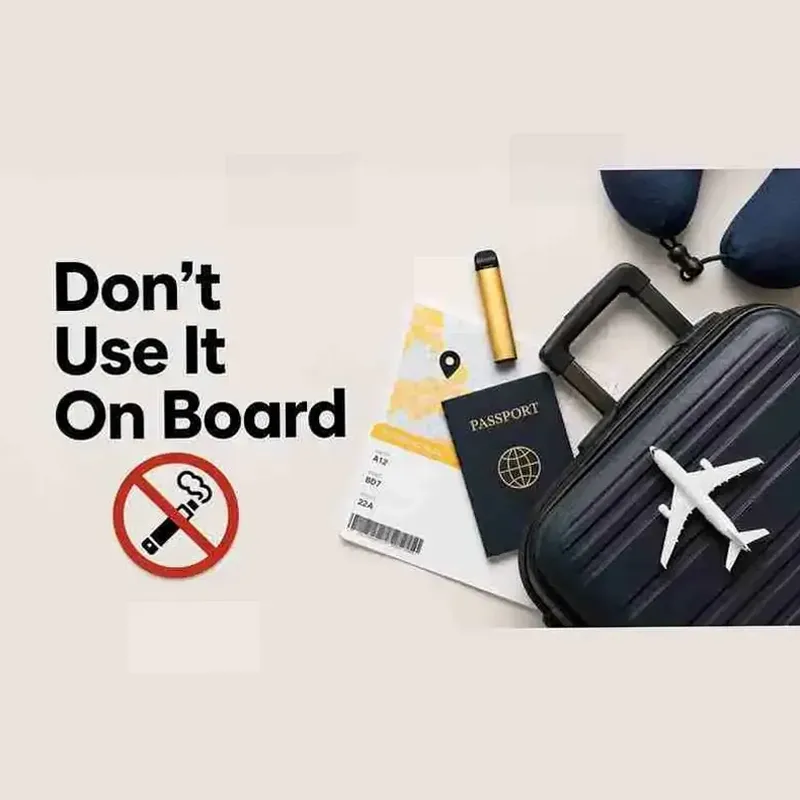
No. The ban covers every inch of a commercial aircraft, bathrooms included. Charging is equally forbidden, so the device stays unplugged from seat USB ports, power outlets, laptops, and power banks.
Where the ban gets its teeth
U.S. Department of Transportation rules (14 CFR Part 252) read “smoking” to include electronic cigarettes and make airlines police it on scheduled passenger flights. Every U.S. carrier is bound, and so is any foreign carrier flying to or from the United States. No corner of the aircraft is exempt — lavatory enforcement is explicitly required.
The charging side flows from the FAA’s hazardous-materials rules for vaping devices. Some carriers reach further: United, for instance, bans vaping and charging even inside its United Club lounges.
Device Limits and the 100 Wh Question
For electronic smoking devices, the FAA limits lithium-ion batteries to 100 watt-hours apiece. When the watt-hour rating is not printed anywhere, check the battery label or the product paperwork. Take no device for granted as automatically under the ceiling.
Passengers are also told to consult their carrier, because airlines may set their own ceilings on devices or batteries carried for personal use. A federal allowance never outranks a stricter airline rule.
No federal device quota exists for vaping hardware. Under FAA guidance, rechargeable batteries below 100 Wh are unlimited provided they serve personal use. Batteries packed with resale or distribution in mind are flatly prohibited.
Battery labeled in milliamp hours (mAh) instead of watt-hours? The FAA formula is volts x mAh / 1000. Example: a 3.7 V battery rated at 1,000 mAh equals 3.7 Wh.
American, Delta, United: The Big Three Compared
All three sit on the federal carry-on-only floor and layer specifics above it. Policies drift, so confirm with your carrier before the flight.
| Airline | Carry-on | Checked bag | On board | Details |
|---|---|---|---|---|
| American Airlines | Yes | No | No use | Carry case recommended. Country rules vary. |
| Delta Air Lines | Yes, for personal use only | No | No use or charging | A protective carry case is suggested. Check customs rules abroad. |
| United Airlines | Yes — carry-on or personal item | No — gate-checked bags included | No use or charging | Vaping and charging are barred in United Club lounges too. |
Sources: American Airlines page on restricted items, Delta policy on tobacco, e-cigarettes and marijuana, United page on dangerous items.
Terminal Rules Are Airport-by-Airport
Each airport legislates for itself. Some run dedicated smoking zones; others push smoking and vaping out of the terminal entirely. Passing security with a device grants zero right to use it inside the building. Check your departure and connection airports ahead of time.
International Flights Stack More Layers On
Run the U.S. carry-on rules for the U.S. leg, then audition every other authority with jurisdiction over the trip. Before wheels-up, confirm:
- the device and battery policy of the operating airline;
- the rules of each transit country and airport;
- possession and import rules at the destination; and
- the return-flight rules that govern outside the United States.
Other countries legislate for themselves. Canada, for instance, lets CATSA (its screening authority) accept e-cigarettes in carry-on bags together with refill liquid in containers of 100 mL or less. Elsewhere, e-cigarette import or use faces restrictions or outright bans, and Delta notes it accepts no responsibility for items local authorities seize.
No retailer article — this one very much included — proves a vape legal in another country. Ask that country’s government or customs office directly.
Packing Checklist in Five Moves
- Cabin or pocket only — the hold is never an option.
- Power it down or lock it wherever the model allows, and shield it from accidental firing.
- Apply TSA’s current liquid limits to pods and bottled e-liquid.
- Rescue the device before any gate-checked bag leaves you.
- Screen the carrier, every transit stop, and the destination one by one.
Traveler Questions, Answered
Q: Must my vape come out of the bag at airport security?
Keep the device within easy reach, then do whatever the TSA officer at the checkpoint asks. Nothing in the official sources here supports a blanket rule either way — that every traveler must, or never needs to, unpack a vape.
Q: My vape accidentally went into a checked bag — what now?
Tell the airline or baggage desk the moment you spot the mistake. Checked baggage is closed to vaping devices, and what can still be done depends on where the bag sits in the handling chain.
Q: Are nicotine-free vapes exempt from the baggage rule?
No exemption. The rule follows the battery-powered hardware itself, regardless of whether the liquid holds nicotine. Keep it with you or in cabin baggage, guarded against accidental firing.
Q: Are disposables allowed on planes?
Yes — cabin bag or your person, nowhere else. Every disposable hides a built-in lithium battery, so even a factory-sealed unit cannot travel checked. Give it a case so it cannot fire by accident.
Q: What about vape pens?
Yes. Vape pens fall under the same FAA grouping as every other vaping device: carry-on only. Where possible, lock the pen or remove its battery, and keep spare terminals covered.
Q: Where does vape juice belong — cabin or hold?
Checked bags may carry e-liquid, per TSA. In the cabin, containers top out at 3.4 oz (100 mL) each. The hardware itself flies with you, never below.
Q: Does this cover THC vapes?
No — nicotine products only. TSA says its officers are not drug hunters, yet anything illegal turned up at screening goes to law enforcement. Delta treats marijuana as federally illegal and bans it aboard. The hardware rules above still apply to any vape.
Q: My device gets hot mid-flight — what do I do?
Tell the crew immediately. FAA guidance says passengers should flag it at once whenever a battery or device overheats, swells, smokes, or burns. Cabin crews drill for lithium battery fires specifically.
Need a replacement before you fly? Skim the current disposable vape collection — but only once your airline and destination have both cleared it.
Sources
Last checked: October 22, 2026.
- TSA page: e-cigarettes and vaping devices
- TSA page: e-liquids
- TSA page: medical marijuana
- FAA PackSafe page: e-cigarettes and vaping devices
- FAA page: airline passengers and batteries
- 14 CFR Part 252 — smoking aboard aircraft
- CATSA page: e-cigarettes and accessories
- American Airlines page: restricted items
- Delta page: tobacco, e-cigarettes or marijuana
- United page: dangerous items
Adult-use notice: This guide is intended for adults aged 21+. Nicotine is addictive. It offers general travel information, not destination-specific legal advice.