
Converted correctly, 5% nicotine in mg is about 50mg per milliliter of e-liquid — 50mg/mL. It is a concentration, not a total: a 2mL pod at 5% starts with about 100mg in its liquid, and a 20mL disposable about 1,000mg before use. And 5% is not the same as 5mg/mL, which equals 0.5%.
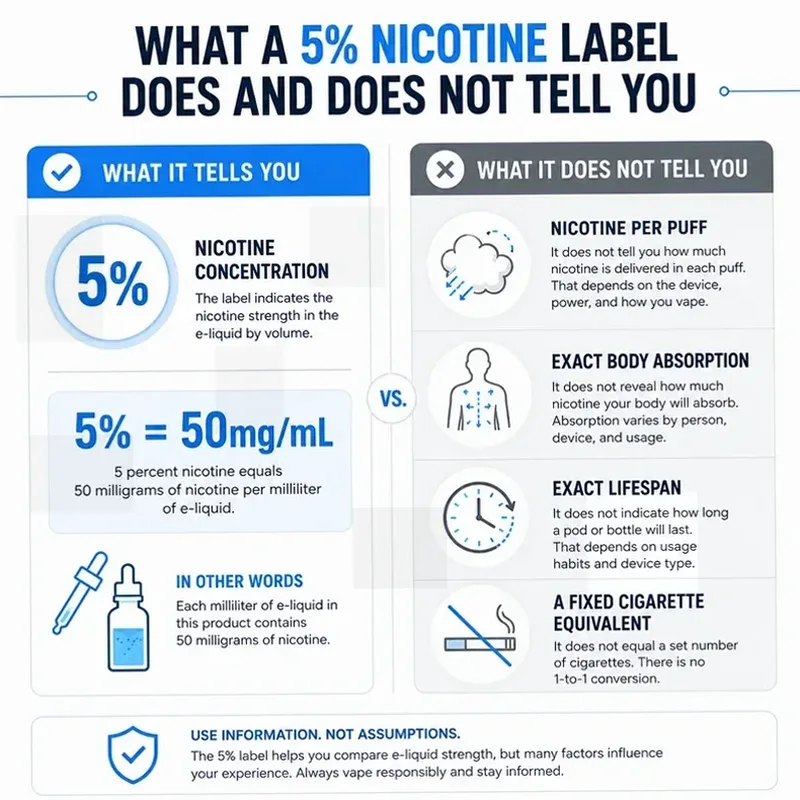
That figure describes the liquid and nothing else. Nicotine in a single puff, what your body absorbs, how long the device runs, how it stacks against some count of cigarettes — all outside its job description.
The Conversion, Plainly
The arithmetic is one step:
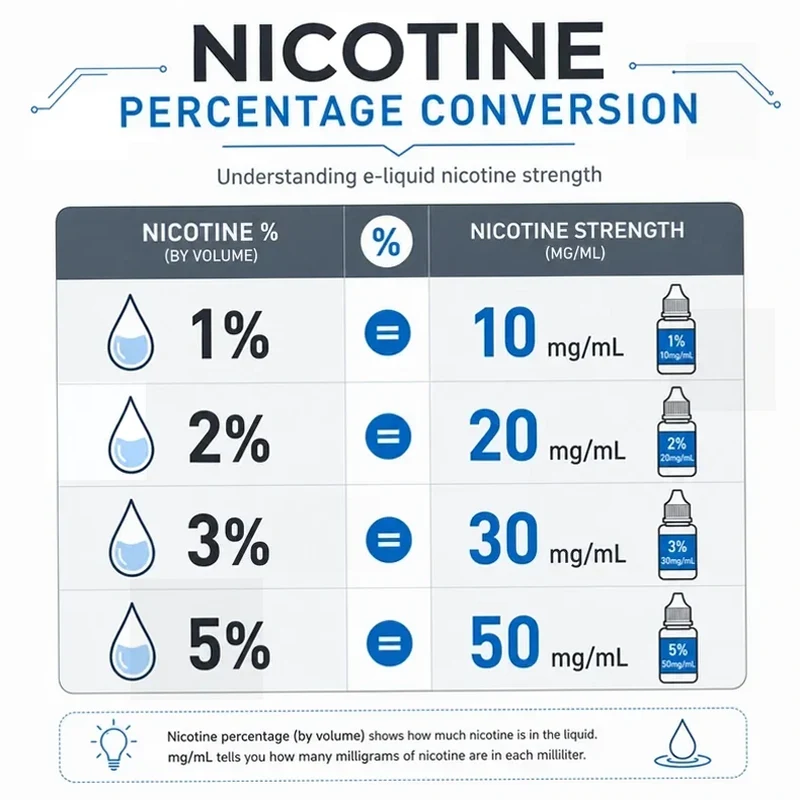
| What the label says | What it means in mg/mL |
|---|---|
| 1% | 10mg/mL |
| 2% | 20mg/mL |
| 3% | 30mg/mL |
| 5% | 50mg/mL |
A package printing 5% is generally saying the liquid holds about 50mg of nicotine in each milliliter. The FDA itself uses the wording “50mg/mL (or 5%)” for certain e-liquid pods — confirmation that the two formats count as equivalent concentration labels in the United States.
The unit is the trap. 5% is not the same as 5mg/mL. A 5mg/mL liquid is 0.5% — one-tenth of the concentration.
What 50mg/mL Does and Does Not Say
mg/mL is milligrams per milliliter — a measure of nicotine concentration in the e-liquid, never the amount a puff delivers.
Fifty milligrams inside every 1mL of e-liquid. Which does not mean:
- each puff carries 50mg;
- 50mg is the device’s whole supply;
- your body takes in 50mg at once;
- or every same-label product delivers nicotine the same way.
Easy labels, easy misreads. In a study of adults who used e-cigarettes, participants repeatedly fumbled comparisons where one strength appeared in mg/mL and the other as a percentage — and the percentage versions tended to look weaker than the identical mg/mL strength.
Concentration Versus Total: Two Different Questions
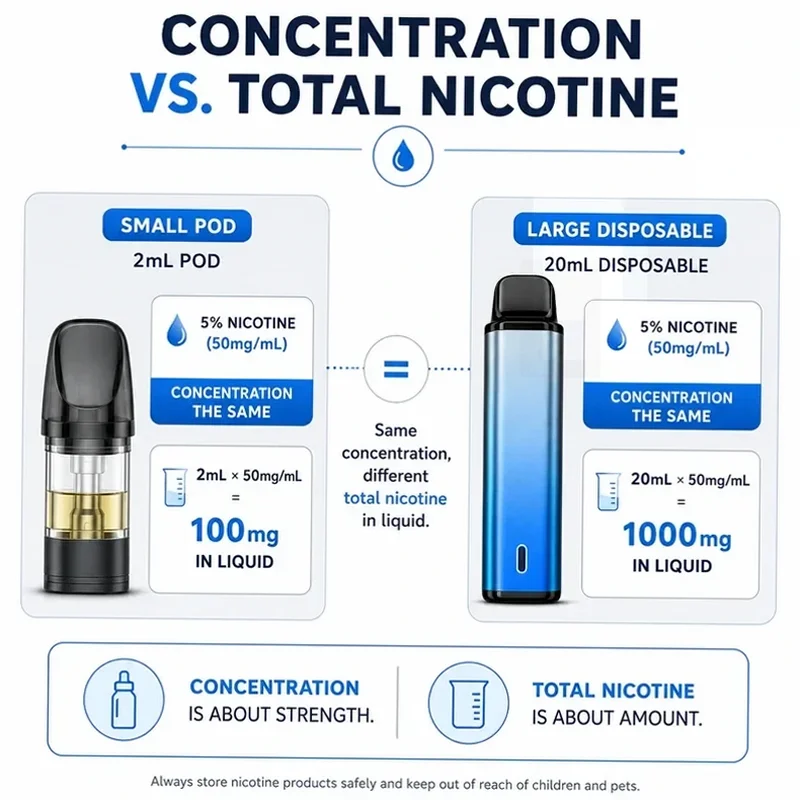
Two products can wear the same 5% label while carrying very different volumes of e-liquid.
For the nicotine held in the full liquid supply, multiply concentration by volume:
| Volume of liquid | Strength | Nicotine in that liquid |
|---|---|---|
| 2mL | 50mg/mL | 100mg |
| 10mL | 50mg/mL | 500mg |
| 20mL | 50mg/mL | 1,000mg |
Those numbers are pre-use liquid contents. They are not what the person using the product absorbs.
So a 2mL prefilled vape pod and a 20mL disposable vape can both say 5% while the larger device holds ten times the liquid. Same concentration — very different total volume of nicotine-containing liquid.
Is 5% Fifty Milligrams Per Puff?
No. The label carries no per-puff dose.
Delivery shifts with the device’s power, coil resistance, nicotine formulation, puff duration and the way the product gets used. Research has logged higher-power devices out-delivering lower-power ones even while running weaker liquid, and puffing behavior itself can change when people switch power settings.
Hence the rule: do not divide 50mg/mL by the advertised puff count. Puff counts are estimates, no two draws match, and nicotine in the liquid is not nicotine in the bloodstream.
Does 5% Count as High?
Among common pod and disposable labels, 5% or 50mg/mL sits at the high end of nicotine concentration.
The percentage disguises it — five just does not sound big. Written in mg/mL, the gaps are easier to see:
- 2% = 20mg/mL
- 3% = 30mg/mL
- 5% = 50mg/mL
To compare current products by labeled strength: Vapmo’s 5% nicotine disposable vapes and lower-nicotine disposable vapes from 0% to 3%.
Per milliliter, 5% carries about 67% more nicotine than 3%, and two and a half times the concentration of 2%.
No universal scale sorts every concentration into low, medium and high, so handle those words with care. Research still shows percentage labels push people to underestimate the strength sitting in front of them.
Nicotine is highly addictive. The FDA’s advice to adults not currently using tobacco products: do not start — not with e-cigarettes, not with anything else.
Does a 5% Label Mean Salts Inside?
Not automatically.
Five percent states the strength, not the chemistry — nicotine salt, freebase or another formulation all remain possible.
Plenty of high-strength pods run salts: at matched strengths, research found salt formulations generally rated smoother and less harsh than freebase. Smoother is not weaker, though — the nicotine content does not drop.
The physical package will say — look for:
- nicotine salt;
- salt nicotine;
- nic salt;
- tobacco-derived nicotine;
- or non-tobacco nicotine.
Never read the formulation off the percentage.
Can You Translate 5% Into Cigarettes?
Not with any trustworthy one-liner.
A real cigarette equivalence needs device details, aerosol output, puff duration, formulation, usage frequency and the individual’s actual absorption. The label supplies one corner of that picture.
That’s why “one milliliter equals a fixed number of cigarettes” claims mislead — passable as rough framing, useless for estimating anyone’s personal nicotine exposure.
Reading a Nicotine Label Properly
Put two products side by side and check four things:
- Concentration: 5%, 50mg/mL, 3% — which form, which strength?
- E-liquid capacity: how many milliliters does the pod or device hold?
- Nicotine type: salt, freebase or another form, per the package?
- Product version: does the strength move with region, flavor or batch?
Nicotine information arrives as percentages, mg/mL, total milligrams per cartridge and more — always read the full unit, never the bare number.
The product page explains which version is selling; the physical package stays the final reference.
Quick Answers to Common Questions
Q: Are 50mg and 5% nicotine the same?
50mg/mL usually maps onto 5% nicotine. A bare “50mg” with no “per mL” is the ambiguous version — it could mean concentration or the product’s total content.
Q: How big is the gap between 5% and 3%?
Big enough: roughly 50mg/mL against roughly 30mg/mL — 5% runs about 67% more concentrated per milliliter.
Q: Do all 5% vapes hit the same?
Not necessarily. Identical concentration, different power, coil design, airflow, formulation and puff character — any of which can move delivery and the feel of the aerosol.
Q: Does 5% say anything about lifespan?
No. Concentration and lifespan are separate specs; lifespan follows e-liquid capacity, battery, power mode, draw length and puff frequency. The how long a vape lasts guide covers how those factors play out across disposables, prefilled pods and rechargeables.
Q: Is 5% secretly just 5mg/mL?
No. Five percent is about 50mg/mL; 5mg/mL is 0.5% — one-tenth of the concentration.
Q: In mg terms, what is 5% nicotine?
About 50mg per mL of e-liquid — multiply by the device’s e-liquid volume for the total held in the liquid.
Q: Does 5% nicotine translate to 50mg/mL?
Yes. The percentage on a vape label is weight per volume, putting 5% at about 50mg/mL. Brands round — check the box for the exact figure.
Q: How much nicotine sits in a 5% vape?
Volume decides: 10mL at 5% holds about 500mg in the liquid, and 20mL about 1,000mg.
Q: Are 5mg and 5% the same thing?
No. 5mg/mL is 0.5% — 5% runs ten times stronger at 50mg/mL.
Where This Leaves You
A 5% nicotine label almost always means about 50mg of nicotine per milliliter in the e-liquid.
Concentration only — not nicotine per puff, not total absorbed, not lifespan, not a cigarette count. Read it beside e-liquid capacity, nicotine type and exact product version to understand what you are holding.
Disclaimer: This article explains nicotine-label terminology and is not medical advice. Nicotine is an addictive chemical. Adults who do not currently use nicotine or tobacco products should not start. Strength, formulation, capacity and labeling vary by product and region; the physical package is the final reference.