
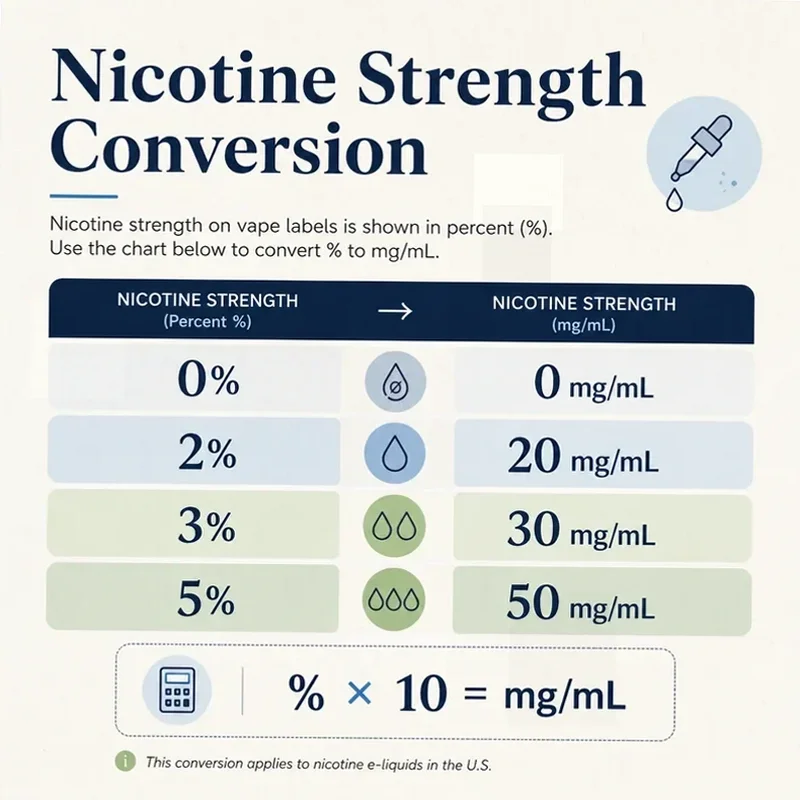
Translated into milligrams, a vape labeled 2% nicotine holds approximately 20 milligrams of nicotine in every milliliter of e-liquid, and a product labeled 3% nicotine works out to approximately 30mg/mL.
Both sit below a 5% or 50mg/mL vape in concentration — and that is all “lower nicotine” means. It is not nicotine-free, and the percentage by itself cannot say how much nicotine a puff delivers or your body absorbs.
The Conversion in One Look
Vape labels generally follow one percentage convention:
| Label on the pack | Same strength written as |
|---|---|
| 0% | 0mg/mL |
| 1% | 10mg/mL |
| 2% | 20mg/mL |
| 3% | 30mg/mL |
| 5% | 50mg/mL |
The basic conversion is:
Nicotine percentage × 10 = concentration in mg/mL
Which gives you:
- 2% = 20mg/mL
- 3% = 30mg/mL
- 5% = 50mg/mL
Units are where the confusion lives. 2% is not 2mg/mL, and 3% is not 3mg/mL — each percentage is ten times the mg/mL figure it gets mistaken for.
In research on adults who use e-cigarettes, people routinely fumbled the comparison between percentage strengths and their mg/mL equivalents. Percentage labels also tended to read as weaker than the identical strength printed in mg/mL.
Unpacking the 2% Label
Read a 2% label as roughly 20mg of nicotine in each milliliter of e-liquid.
That is a statement about the liquid’s concentration, nothing more. It does not mean:
- 20mg is everything the device holds;
- each puff hands over 20mg;
- or your body soaks up 20mg in one sitting.
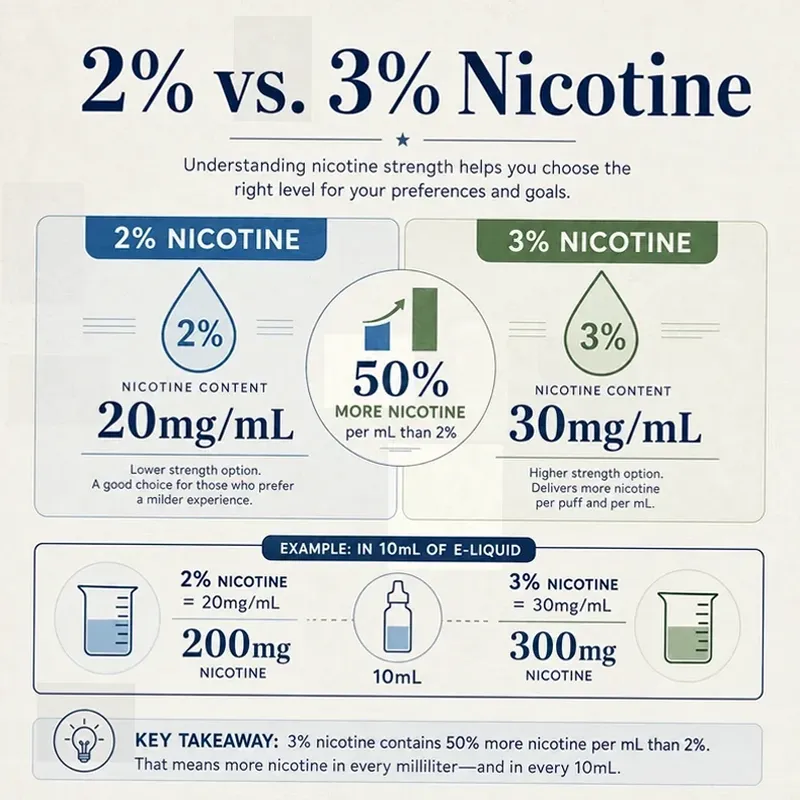
Take a device holding 10mL of 2% e-liquid:
10mL × 20mg/mL = 200mg of nicotine in the original liquid supply
That number is the pre-use content of the liquid, not a measurement of what any person finally absorbs.
Unpacking the 3% Label
The 3% label reads out at roughly 30mg of nicotine per milliliter of liquid.
Run the same 10mL example:
10mL × 30mg/mL = 300mg of nicotine in the original liquid supply
More concentrated than 2%, yes. The label still stays silent on the exact per-puff amount and on how the product will feel in use.
Setting 2% and 3% Side by Side
Per-milliliter nicotine makes the cleanest comparison:
| What is compared | at 2% | at 3% |
|---|---|---|
| Strength | 20mg/mL | 30mg/mL |
| Nicotine inside 10mL | 200mg | 300mg |
| Against 5% | 40% of its strength | 60% of its strength |
Per milliliter, a 3% liquid carries 50% more nicotine than a 2% liquid.
That math compares liquids and nothing else. It does not prove each puff off a 3% device delivers exactly 50% more nicotine than one off a 2% device.
Is “Lower Nicotine” Actually Low?
Not automatically.
In this article, “lower nicotine” only means less concentrated than the 5% products common across U.S. disposables and closed pods.
The arithmetic is straightforward:
- 2% sits below 3%;
- 3% sits below 5%;
- and 0% means no nicotine is listed.
But “low” is no standardized measure of personal exposure — the delivered amount still rides on the device and how it gets used.
The higher concentration gets a full walkthrough in What Does 5% Nicotine Mean? 50mg/mL Explained.
Vapmo’s current lower-nicotine disposable vapes from 0% to 3% are browsable too.
Nicotine is highly addictive, and the FDA tells adults who do not currently use tobacco or nicotine products not to start with e-cigarettes.
Why Two 3% Vapes Can Feel Different
A 3% label covers the liquid, not the whole vaping system around it.
Delivery also bends around:
- device power;
- coil resistance and heater design;
- airflow;
- the nicotine formulation;
- how long each puff lasts;
- how much each puff moves;
- and how often you puff.
Research shows power and concentration interact: in some matchups, a higher-powered device on lower-concentration liquid out-delivered a lower-powered device on stronger liquid.
That is why nobody can automatically call a 2% product “two-thirds the nicotine” of a 3% product in real-world use.
The concentration comparison stands; a precise delivery comparison would need those exact devices tested under defined conditions.
Concentration Is Not Total Nicotine
Capacity still counts.
A small pod and a large disposable can both hold 2% liquid — the larger device simply carries more liquid, and with it more nicotine across the full supply.
| Example | Strength | Capacity | Nicotine in the liquid |
|---|---|---|---|
| Compact pod | 2% / 20mg/mL | 2mL | 40mg |
| Large disposable | 2% / 20mg/mL | 20mL | 400mg |
| Compact pod | 3% / 30mg/mL | 2mL | 60mg |
| Large disposable | 3% / 30mg/mL | 20mL | 600mg |
Those figures are the nicotine sitting in the original liquid — not what reaches the bloodstream.
Four ideas, kept apart:
- Concentration is nicotine per milliliter.
- Capacity is how much liquid the product carries.
- Total nicotine in the liquid multiplies the two together.
- Nicotine exposure follows the device and the behavior.
Does 2% or 3% Guarantee Nicotine Salt?
It does not.
A percentage states the concentration and says nothing about the formulation.
The liquid inside may be:
- nicotine salt;
- freebase nicotine;
- tobacco-derived nicotine;
- or non-tobacco nicotine.
Two products can carry the same 3% label on different formulations. Trust the selected product page and the physical package — not an assumption drawn from the percentage.
Where the Label Stops Talking
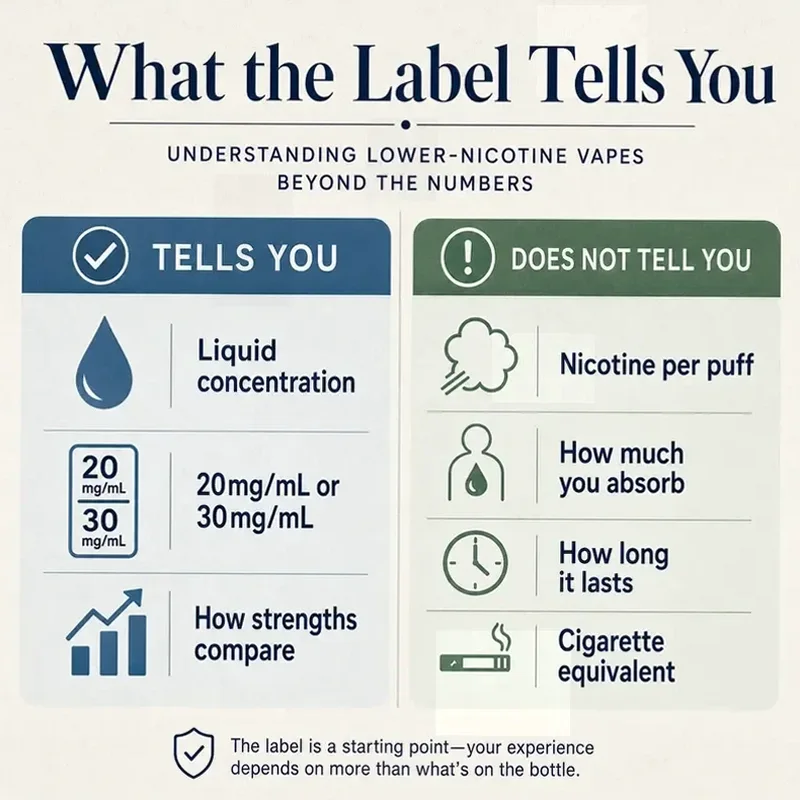
Concentration, yes. Beyond that, a 2% or 3% label stays quiet about:
- the exact nicotine in any single puff;
- the exact amount your body absorbs;
- how long the product will run;
- or any fixed cigarette equivalent.
Puff length, device output and behavior all move delivery — which is why formulas like “one milliliter equals a fixed number of cigarettes” fail at estimating anyone’s exposure.
Comparing Lower-Nicotine Vapes Without Guesswork
Read these four details as a set instead of stopping at the percentage.
1. The concentration itself
Pin down the exact label:
- 0%;
- 2% or 20mg/mL;
- 3% or 30mg/mL;
- 5% or 50mg/mL;
- or another strength.
Shoppers weighing the higher end can also use Vapmo’s separate collection of 5% nicotine disposable vapes.
2. How much liquid it holds
Larger capacity, more nicotine-containing liquid in total — even at an unchanged concentration.
3. The device doing the work
Power, heating system, coil resistance and airflow all shape the aerosol and the nicotine riding it.
4. The exact version you are buying
Strength can shift with region, flavor, version or batch. Start at the product page; end at the physical package in your hands.
The Questions People Ask
Q: Does 2% nicotine equal 20mg?
In practice, 2% lines up with 20mg/mL. A bare “20mg” with no “per mL” muddies the picture — it could mean concentration or total content.
Q: Does 3% nicotine equal 30mg?
Yes — the common vape-label conversion puts 3% at approximately 30mg/mL.
Q: How much stronger is 3% than 2%?
Fifty percent more per milliliter. Actual delivery still varies with the device and the usage.
Q: Do 2% and 3% count as nicotine-free?
No — both contain nicotine. Only a 0% or 0mg/mL label indicates no listed nicotine.
Q: Will a lower percentage stretch a vape’s lifespan?
Not by itself. Strength and lifespan are separate specs — capacity, battery, power mode, draw length and puff frequency move duration far more directly.
The how long a vape lasts guide walks through capacity, puff ratings and power settings across disposables, pods and rechargeables.
What to Carry Away
A 2% nicotine vape works out to approximately 20mg/mL; a 3% nicotine vape to approximately 30mg/mL.
Three percent runs 50% stronger than two, and both sit below 5%. The percentage reveals nothing about nicotine per puff, exact absorption, device lifespan or any cigarette conversion.
Weigh concentration alongside e-liquid capacity, device design, nicotine formulation and the exact product version.
Disclaimer: This article explains nicotine-label terminology and is not medical advice. Nicotine is an addictive chemical. Adults who do not currently use nicotine or tobacco products should not start. Strength, formulation, capacity, packaging and regional specifications may vary; the selected product page and the physical package are the final references.